PLSC 1.0 Syntax
Draft status: This content reflects the current working spec and may be revised.
1. What is PLSC?
Phenotype List String Code (PLSC) pairs a PL String with its namespace and version (or date) so that every expression is self-contained and traceable.
<namespace>#<version or date>#<pl-string>
- Namespace — who defines the vocabulary (e.g.,
who,optn,et,nmdp) - Version or date — a release tag (preferred) or ISO date (YYYY-MM-DD)
- PL String — a phenotype expression using the operators below
Use a release version when available (e.g.,
3.61.0). If not, use the date the reagent/result/interpretation was produced.
2. Namespaces
A namespace represents a governed, versioned code system (or a set of systems with one base). Examples:
who— Base: IPD-IMGT/HLA release; Extensions: WHO antigen names, NMDP MAC codes for ambiguity, and other well-documented, versioned tables.optn— OPTN antigen/epitope codes used in U.S. allocation workflows.et— Eurotransplant antigen/match determinant tables.nmdp— registry codes (including MACs), aligned to specific IMGT/HLA releases.
Gene family namespace
Each gene family namespace represents one or more code systems. When more than one code system is used, a base system is designated which is then extended by the other code systems.
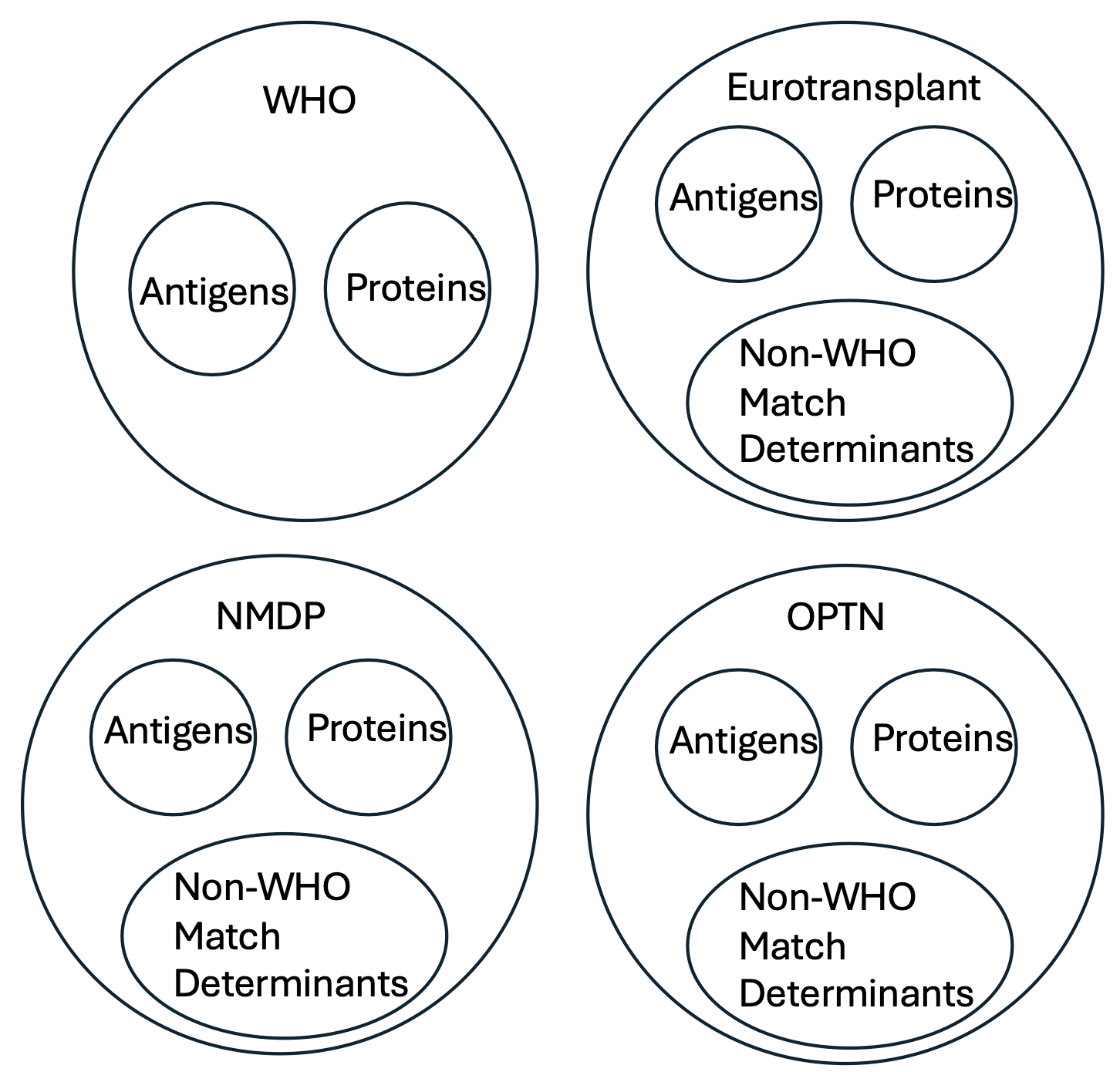 |
- who — Base: IPD-IMGT/HLA release; Extensions: WHO antigen names,
NMDP MAC codes for ambiguity, and other well-documented, versioned tables.
- optn — OPTN antigen/epitope codes used in U.S. allocation workflows.
- et — Eurotransplant antigen/match determinant tables.
- nmdp — registry codes (including MACs), aligned to specific IMGT/HLA releases.
|
Rules
- A PLSC must specify exactly one namespace and one version (or date).
- No mixing of namespaces within a single PL String.
- Each implementation should publish its governance, release process, and documentation for users.
3. PL String grammar
PL String encodes phenotypes (not genotypes). It represents the presence or possible presence of proteins/antigens and heterodimer pairing for class II. It does not carry chromosomal phase, zygosity, or locus order.
3.1 Delimiters and precedence
| Precedence | Delimiter | Name | Meaning (phenotype context) | Typical context |
|---|---|---|---|---|
| 1 | + |
AND | All listed molecules/antigens are present (e.g., on a bead; in a result) | All contexts |
| 2 | ~ |
Heterodimer | Exactly two elements form one heterodimer (class II α~β) | DQ, DP, DR (protein/antigen) |
| 3 | % |
Inclusive OR | One or more of the listed items may be present | Antigen lists; multi-reactivity |
| 4 | / |
Exclusive OR | Exactly one of the listed items is present (ambiguity) | Protein-level ambiguity (e.g., MAC) |
Notes:
+binds most tightly (1),/loosest (4) for unambiguous parsing.%(inclusive OR) is primarily for antigen ambiguity/association./(exclusive OR) encodes protein ambiguity (e.g., unresolved allele).~is only valid for appropriate α~β pairs per the chosen namespace.
3.2 Basic rules
- No loci/phase semantics: PL Strings do not assert chromosomal phase,
cis/trans, zygosity, or locus order;
DPA1*01:04~DPB1*02:02is equivalent toDPB1*02:02~DPA1*01:04. - Slash locus constraint: Terms on either side of
/must be the same locus/category within the namespace (e.g.,HLA-A*01:01/HLA-A*01:02is valid; mixingAwithBis not). - Heterodimers:
~may only connect permitted α~β pairs as defined by the namespace (e.g.,DQA1~DQB1,DPA1~DPB1,DRA~DRB3/4/5or their antigen equivalents). - No mixed namespaces inside a single PL String.
- Whitespace is not significant; implementers should normalize.
3.3 Examples
Reagent (protein ambiguity on a bead)
HLA-A*01:01/HLA-A*01:02+HLA-A*02:01
A*02:01is present;A*01:01orA*01:02(but not both) is present.
Result (antigen-level inclusive ambiguity)
A0101%A0102+A2402
A2402 present; A0101 and/or A0102 may be present.
Class II heterodimers (protein level)
HLA-DQA1*05:01~HLA-DQB1*02:01%HLA-DPA1*01:03~HLA-DPB1*04:02
One or both heterodimers may be present.
Constrained heterodimer variants
HLA-DPA1*01:04~HLA-DPB1*02:01%HLA-DPA1*01:04~HLA-DPB1*04:02
One or two heterodimers;
DPA1*01:04is always present.
Multiple loci (phenotype list)
HLA-A*01:02+HLA-A*02:01+HLA-B*07:02
A*01:02,A*02:01, andB*07:02present.
Implementations should reject invalid pairs like
DQA1*05:01~DPB1*04:02based on namespace pairing rules.
4. PLSC construction
Syntax
namespace#version_or_date#plstring
Version: Prefer authoritative release tags (e.g., 3.61.0).
Date: If no release applies, use ISO YYYY-MM-DD. The date reflects when
the reagent/result/interpretation was produced—not sample collection/export.
4.1 Examples
- IPD-IMGT/HLA release bound protein list:
who#3.61.0#HLA-A*01:01/HLA-A*01:02+HLA-A*24:02 - Class II heterodimers with antigen mapping:
who#2025-11-02#DQA1*05:01~DQB1*02:01%DPA1*01:03~DPB1*04:02 - Ambiguous MAC usage (namespace-governed):
nmdp#2025-11-02#HLA-DQB1*03:01/297+HLA-DQB1*06:02
5. Validation checklist
- Namespace present and recognized.
- Version or date present and well-formed.
- No mixed namespaces within
<pl-string>. - Operators parse with precedence:
+>~>%>/. - Slash locus constraint holds on every
/. - Heterodimer pairs are permitted by the namespace.
- Atoms exist in the declared namespace release/date.
6. Embedding in exchange formats
- FHIR: Use as a
Codingwithsystem(e.g.,http://plstring.org),version(namespace release or date), andcode(the full PLSC string). - HAML: Store as the code value for reagent/result/interpretation elements.
- No mixing of namespaces inside one code value; use separate codings for different namespaces.
FHIR example
<valueCodeableConcept>
  <coding>
    <system value="http://plstring.org"/>
    <version value="1.0"/>
    <code value="who#3.61.0#HLA-DQA1*05:01~HLA-DQB1*02:01+HLA-DPB1*04:01"/>
  </coding>
</valueCodeableConcept>
7. Comparison to GL-String (at a glance)
| Concept | GL-String (genotype) | PL String (phenotype) |
|---|---|---|
| Focus | Alleles/genotypes & phase | Proteins/antigens & heterodimers |
| Locus delimiter | ^, |, ? (various) |
Not used |
| Exclusive OR | / (allele ambiguity) |
/ at protein level |
| Inclusive OR | (N/A) | % at antigen level |
| Heterodimer | ~ for phase |
~ for α~β pairing (class II) |
| Composition | + |
+ (reagent contents; multi-reactivity) |
| Mix namespaces | Allowed per implementer | Disallowed within a single PL String |
8. Frequently asked
Can I encode epitopes/eplets?
Not in this version. Once stable, widely adopted nomenclatures are available,
the grammar can extend to epitope atoms (e.g., OPTN DPB1 unacceptable
epitopes, eplet registries).
What about non-classical loci (E, F, G) or MICA/MICB/ABO?
Permitted if your namespace publishes governed vocabularies; apply the same
operators and rules.
This page supersedes earlier drafts and aligns operator semantics (+, ~,
%, /), constraints (no mixed namespaces; heterodimer pairing rules), and
PLSC binding (namespace + version/date) with the current manuscript. It replaces
the older GL-centric placeholder text.